


SOLAR POWER IN NEW YORK
Limestone Solar
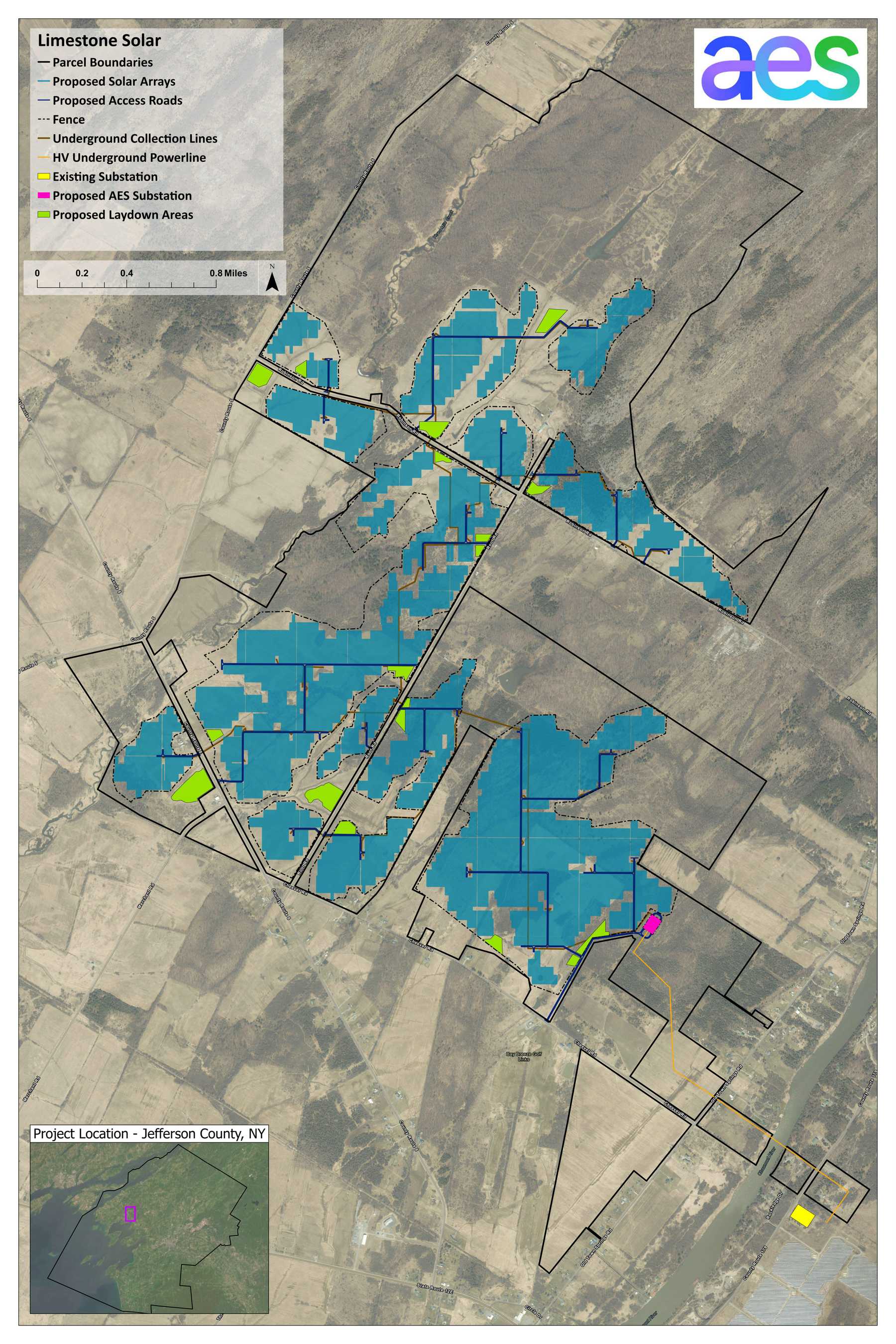
AES’ Limestone Solar project is planned utility-scale solar facility located in the Town of Lyme, in Jefferson County, New York. This project will allow for continued production of clean energy, as well as help diversify the state’s energy resources while delivering affordable and reliable energy to meet New York’s rapidly growing electricity demand.


150 MW planned capacity

Enough clean energy to power over 20,000 homes annually

Located in Jefferson County, NY
Project updates
Our clean energy commitment
AES’ Limestone Solar project is a planned facility in New York. We are committed to responsible clean energy development that creates long-term value and positive impact for both the environment and local communities.

Economic and environmental benefits
We believe in being a good neighbor, ensuring responsible clean energy development that benefits both the environment and local communities without burdening existing infrastructure.
$ millions in tax revenue
expected to be generated for the local community over the lifetime of the project
Local jobs to be created
over the course of construction
Project details
- Plans to connect the Lyme to Coffeen 115kv line
- At the end of the project's life, a decommissioning plan allows for the land to return to agricultural use or other uses consistent with land-use policies at the time
Clean energy benefits
local communities

Long-term tax revenue to counties, towns and school districts

Landowner income diversification, keeping land in the family

Local economic stimulus during construction

Affordable, reliable and locally produced clean energy

Low-cost source of electricity that supports local energy security
Expected project timeline

2025-2027
Project preparation
Development, Siting, Permitting

2028
In Development
Construction

2029
Operational
Operations
Project updates

SUSTAINABILITY RESOURCES
Sustainability best practices
At AES, we understand that our success as a company is only as strong as our partnerships with the communities where we operate. That’s why we partner with communities, customers, state agencies, higher education, elected officials, and other key stakeholders to see how we can best work together to support sustainable social and economic development.
Environmental and technical studies
We conduct a series of studies that ensure our projects are thoughtfully and responsibly designed.
- Wetland and waterbody delineation
- Habitat assessment
- Marsh bird survey
- Breeding Bird survey
- Rare Plant survey
- Winter raptor survey
- Hydrology study
Local partnerships
At AES, we understand that our success as a company is only as strong as our partnerships with the communities where we operate. That’s why we partner with communities, customers, state agencies, higher education, elected officials, and other key stakeholders to see how we can best work together to support sustainable social and economic development.
In Jefferson County, AES is a proud supporter of:
- North Country Chamber of Commerce – Watertown
- Career Jam Sponsor 2023 and 2024
- IBEW Local 910
- United Way of Watertown
- Lyme Free Library
- Jefferson-Lewis-Oneida-St. Lawrence BOCES
- Three Mile Bay Fire Department
Article VIII Permit Application Process
ORES and the RAPID Act
Effective April 20, 2024, the Renewable Action through Project Interconnection and Deployment (RAPID) Act (L 2024, ch 58, part O) repealed Executive Law § 94-c and enacted a new Public Service Law article VIII entitled “Siting of Renewable Energy and Electric Transmission” (Article VIII). The RAPID Act consolidates the environmental review, permitting, and siting of major renewable energy facilities and major electric transmission facilities under the purview of the Office of Renewable Energy Siting and Electric Transmission (Office or ORES).
The RAPID Act also transferred ORES’s regulations at 19 NYCRR part 900 (Part 900) to 16 NYCRR chapter XI, and continued Part 900 in full force and effect subject to conforming changes, such as the substitution of numbering, names, titles, citations, and other non-substantive changes to be filed with the Secretary of State. Effective July 17, 2024, the conforming changes were filed with the Secretary of State as a new 16 NYCRR part 1100 (Part 1100).
The text of the new Part 1100 currently in effect may be accessed at ORES Regulatory Documents.
Article VIII Permitting Timeline

How to receive notices
Join the Limestone Solar stakeholder list.
Joining the Stakeholder List enables you to receive mailings of the Article VIII required notices.
You can join this list by:
Filling out the "Contact Us" webform at the bottom of this page
Calling 866-757-7697
Emailing limestonesolar@aes.com
Subscribe to the Limestone Solar service list once the permit application has been submitted.
Requesting Party Status
Article VIII Permit Application Examination
To learn more about the Article VIII permitting process, please visit the Office of Renewable Energy Siting website at https://ores.ny.gov/.
The final Article VIII regulations are available at Chapter XI, Title 16 of NYCRR Part 1100 (Subparts 1100-1 - 1100-15)
Resources related to the PSC Document Matter Master system, local agency account funds, and regulatory documents can be viewed on the ORES website at https://ores.ny.gov/resources
Information on the Article VIII permit applications currently under review and those which have been deemed complete, can be found at https://ores.ny.gov/permit-applications
Limestone Solar
The application, once filed, can be examined during normal business hours at the Office of Renewable Energy Siting and Electric Transmission, as well as at the local libraries served in accordance with section 1100-1.6(a)(6) of this Part.
The addresses of these locations are:
Office of Renewable Energy Siting (ORES) c/o: OGS Mailroom Empire State Plaza 240 State Street P-1 South, J Dock Albany, N.Y. 12242
Town of Lyme Town Hall: 12175 NY-12E, Chaumont, NY 13622
Availability of Local Agency Account (Intervenor) Funds
Intervenor funding is money that Applicants make available to qualified, locally affected parties and municipalities to offset certain expenses they incur in participating in the state permitting process. These funds are meant to encourage early and effective public involvement in project development and permitting.
With the filing of its Article VIII permit application, Limestone Solar will submit the required local agency account fee. These funds can be sought by local community intervenors and host towns. 75% of funds are reserved for municipalities.
Any local agency or potential community intervenor seeking funding must submit a request for initial funding within 30 days of the date of application filing.
Additional details regarding requests for local agency account funding will be provided once the Limestone Solar Article VIII has been submitted to ORES.
Requests for local agency account funds can be made via:
The ORES Request for Local Agency Account Funding form available in the Resources section of the ORES website
Or by email to general@ores.ny.gov
Or by mail to Attention: Request for Local Agency Account Funding Office of Renewable Energy Siting Empire State Plaza 240 State Street P-1 South, J Dock Albany, NY 12242
If you have questions regarding the intervenor process, please contact the ORES office.
Contact ORES
To submit any questions or comments regarding the Article VIII permitting process, reach out to ORES by phone, email or written letter.
Phone: (518) 473-4590
Email: general@ores.ny.gov
Mailing information (letters and envelopes):
Office of Renewable Energy Siting (ORES)
c/o OGS Mailroom Empire State Plaza
240 State Street P-1 South, J Dock
Albany, NY 12242
Contact us
We want to hear from you! We appreciate your interest in AES’ Limestone Solar. Please contact us directly at: