


SOLAR POWER IN NEW YORK
Cayuga solar project
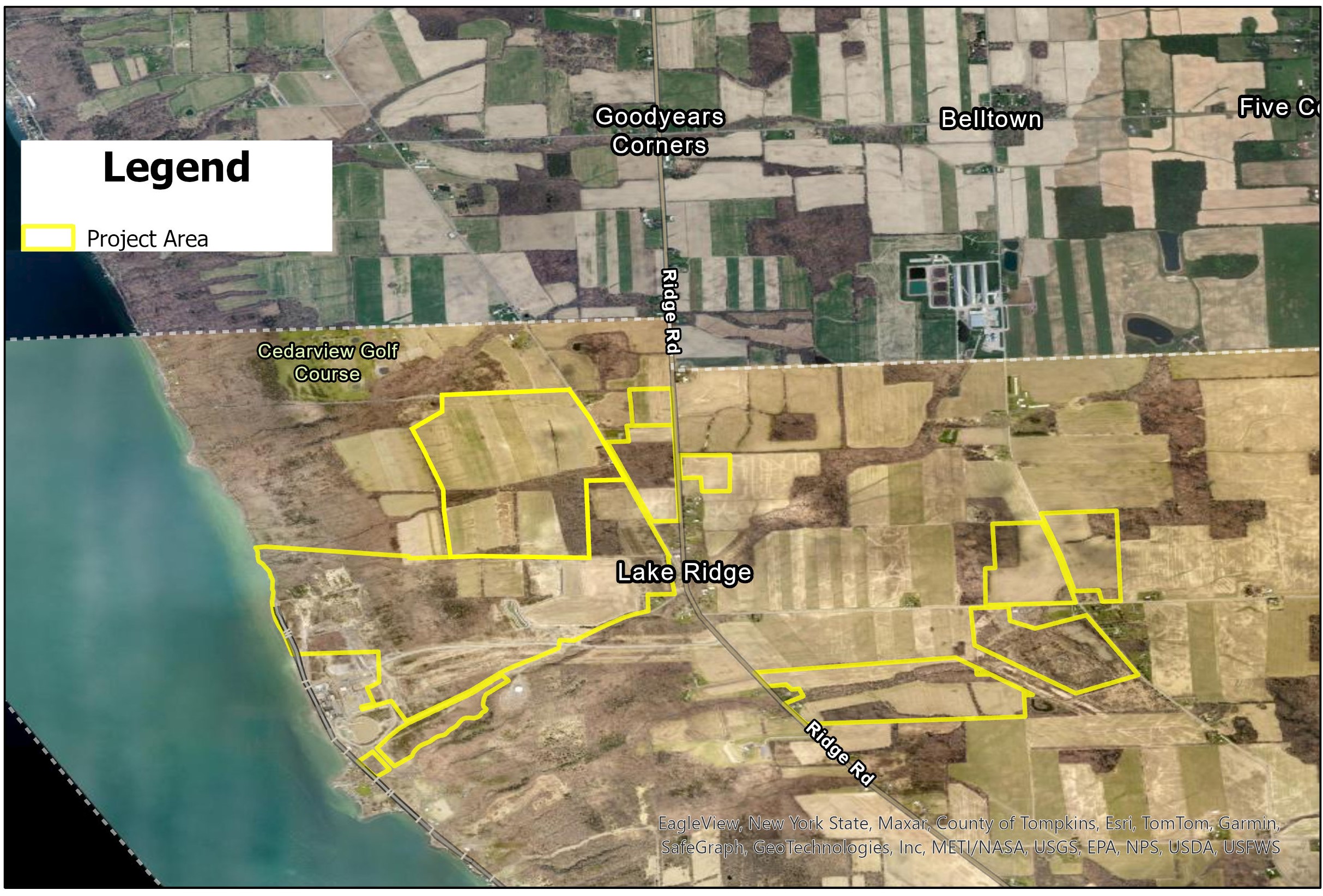
AES’ Cayuga solar project is a planned solar generation facility that will be located in the Town of Lansing, Tompkins County, New York. The Cayuga solar project will help diversify the state’s energy resources while delivering affordable and reliable energy to meet New York’s rapidly growing electricity demand.


60 MW planned capacity
Enough clean energy to power the equivilent of 18,000 homes

Located in Tompkins County, NY
Project updates
Project details
- Sited on approximately 500 acres of privately owned land
- AES will be the long-term owner and operator of the facility
- At the end of the project's life, a decommissioning plan allows for the land to return to agricultural use or other uses consistent with land-use policies at the time
Our clean energy commitment
AES’ Cayuga solar project is a planned facility under construction in New York. We are committed to responsible clean energy development that creates long-term value and positive impact for both the environment and local communities.

Article VIII permit application process
ORES and the RAPID Act
Effective April 20, 2024, the Renewable Action through Project Interconnection and Deployment (RAPID) Act (L 2024, ch 58, part O) repealed Executive Law § 94-c and enacted a new Public Service Law article VIII entitled “Siting of Renewable Energy and Electric Transmission” (Article VIII). The RAPID Act consolidates the environmental review, permitting, and siting of major renewable energy facilities and major electric transmission facilities under the purview of the Office of Renewable Energy Siting and Electric Transmission (Office or ORES).
The RAPID Act also transferred ORES’ regulations at 19 NYCRR part 900 (Part 900) to 16 NYCRR chapter XI, and continued Part 900 in full force and effect subject to conforming changes, such as the substitution of numbering, names, titles, citations, and other non-substantive changes to be filed with the Secretary of State. Effective July 17, 2024, the conforming changes were filed with the Secretary of State as a new 16 NYCRR part 1100 (Part 1100).
The text of the new Part 1100 currently in effect may be accessed at ORES Regulatory Documents.
Application Summary
Cayuga Solar is a proposed 60 MWac solar facility located in the Town of Lansing, New York. The project will span approximately 320 acres across six parcels, including portions of the former Milliken Station electric generating facility and surrounding agricultural lands. As part of the project, AES is developing an advanced 40‑acre agrivoltaics research and demonstration facility, the Cayuga Solar Research Facility, designed to evaluate the co‑location of solar energy and agricultural production.
The Agrivoltaic Project will include up to seven unique solar array configurations, testing variables such as inter‑row spacing, leading‑edge height, and tracker type. This dedicated research area will generate approximately 5 MWdc of solar energy while providing researchers and local farmers with the opportunity to study crop performance, soil health, microclimatic conditions, and agricultural productivity under varying solar designs. Through this design, the Cayuga Solar Research Facility will establish a controlled environment where racking systems can be evaluated side-by-side at the same site.
Once operational, Cayuga Solar will produce enough clean, renewable electricity to power tens of thousands of homes across New York State, contributing to the state’s climate and clean‑energy goals. By integrating solar generation with active agricultural use, the facility will help demonstrate how renewable energy projects can expand clean‑energy production while preserving and enhancing farmland viability.
Power generated by the Solar Facility will connect into the New York power grid through the NYISO interconnection process. The Facility will utilize newly constructed collection lines and infrastructure designed to meet all applicable engineering and environmental standards, with the Agrivoltaic Project fenced and accessed separately from the utility‑scale array.
Through careful planning and design, the Applicant has demonstrated that the construction and operation of the Cayuga Solar Facility will avoid or minimize environmental and community impacts to the maximum extent practicable. Key categories of potential environmental impact analyzed include:
Streams and Wetlands
Agricultural Resources
Cultural and Archaeological Resources
Terrestrial Ecology and Wildlife
Threatened and Endangered Species
Visual Resources
Comprehensive studies, supported by engineering and environmental analysis, have informed the Facility layout and mitigation measures. The Agrivoltaic Project, in particular, enhances environmental benefits by incorporating agricultural activity, soil conservation practices, and research‑driven land management.
To learn more about the Cayuga Solar project, including impact assessments, environmental studies, and permitting documentation, please visit the project’s dedicated ORES/DMM docket, accessible here.
Article VIII Permitting Timeline

Cayuga Solar Permitting Milestones
On September 18, 2024, the Cayuga Solar team presented the project to the Town of Lansing Town Board, introducing the Solar Facility and outlining the steps in the permitting process.
On September 26, 2024, AES met with Lansing Town officials to review project details, discuss local permitting considerations, and coordinate next steps.
On October 2, 2024, AES hosted a Community Meeting at the Lansing Community Center to share project information, answer questions, and provide the community with an overview of the Article VIII permitting timeline. Meeting materials were posted on the project website following the event.
Throughout late 2024, Cayuga Solar prepared its Article VIII permit application, including environmental studies, engineering designs, and community outreach documentation required by the Office of Renewable Energy Siting (ORES).
On October 16, 2025, Cayuga Solar submitted an Article VIII permit application to ORES, officially initiating the state siting review process for the 60 MWac Solar Facility and the 40‑acre Agrivoltaics Research Facility.
Cayuga Solar is currently undergoing ORES review and continues to meet Article VIII communication requirements, including maintaining the project website, issuing mailers to nearby residents and businesses, and publishing notices in local newspapers.
The project is expected to receive a final Article VIII siting permit in Q1 of 2026, pending completion of the ORES review and compliance filings.
In parallel, Cayuga Solar entered the NYISO Cluster Study process in 2024, a key step in securing grid interconnection. The project will continue through subsequent NYISO study phases as required.
As the permitting process advances, Cayuga Solar will continue engaging with local officials, community members, and regulatory agencies to ensure transparency and meet all state and local requirements.
How to recieve notices
Join the Cayuga Solar Stakeholder List.
Joining the Stakeholder List enables you to receive mailings of the Article VIII required notices.
You can join this list by:
Fill out the 'Contact Us’ webform at the bottom of this page.
Call 866-757-7697.
Emailing cayugasolar@aes.com.
Requesting Party Status here (see top right corner for “Request Party Status”)
Article VIII Permit Application Examination
To learn more about the Article VIII permitting process, please visit the Office of Renewable Energy Siting website at https://ores.ny.gov/.
The final Article VIII regulations are available at Chapter XI, Title 16 of NYCRR Part 1100 (Subparts 1100-1 - 1100-15)
Resources related to the PSC Document Matter Master system, local agency account funds, and regulatory documents can be viewed on the ORES website at https://ores.ny.gov/resources
Information on the Article VIII permit applications currently under review and those which have been deemed complete, can be found at https://ores.ny.gov/permit-applications
How to examine the Cayuga Solar Article VIII Permit Application
The application, once filed, can be examined during normal business hours at the Office of Renewable Energy Siting and Electric Transmission, as well as at the local libraries served in accordance with section 1100-1.6(a)(6) of this Part.
The addresses of these locations are:
Office of Renewable Energy Siting (ORES): Three Empire State Plaza, Albany, NY, 12223-1350
Lansing Community Library: 27 Auburn Road Lansing, NY 14882
Availability of Local Agency Account (Intervenor) Funds
Intervenor funding is money that Applicants make available to qualified, locally affected parties and municipalities to offset certain expenses they incur in participating in the state permitting process. These funds are meant to encourage early and effective public involvement in project development and permitting.
With the filing of its Article VIII permit application, Cayuga Solar will submit the required local agency account fee. These funds can be sought by local community intervenors and host towns. 75% of funds are reserved for municipalities.
Any local agency or potential community intervenor seeking funding must submit a request for initial funding within 30 days of the date of application filing.
Additional details regarding requests for local agency account funding will be provided once the Cayuga Solar Article VIII application has been submitted to ORES.
Requests for local agency account funds can be made via:
The ORES Request for Local Agency Account Funding form available in the Resources section of the ORES website
Or by email to general@ores.ny.gov
Or by mail to Attention: Request for Local Agency Account Funding Office of Renewable Energy Siting Empire State Plaza 240 State Street P-1 South, J Dock Albany, NY 12242
If you have questions regarding the intervenor process, please contact the ORES office.
Contact ORES
To submit any questions or comments regarding the Article VIII permitting process, reach out to ORES by phone, email or written letter.
Phone: (518) 473-4590
Email: general@ores.ny.gov
Mailing information (letters and envelopes): Office of Renewable Energy Siting (ORES) c/o OGS Mailroom Three Empire State Plaza, Albany, NY, 12223-1350
Economic and environmental benefits
We believe in being a good neighbor, ensuring responsible clean energy development that benefits both the environment and local communities without burdening existing infrastructure.
Potential environmental and health impacts
The Cayuga Solar project is designed to bring new clean‑energy generation to the region while working closely with local communities, environmental professionals, and regulatory agencies. As part of the state’s Article VIII permitting process, the project undergoes a detailed review of all potential environmental and health impacts. Below is a high‑level overview of the areas evaluated and the types of impacts that are typically considered.
Protecting wildlife and natural habitats
The project is located near the Cayuga Shores Wildlife Management Area (WMA). As part of its environmental review, the project evaluates:
- Potential disturbance to wildlife habitat and movement corridors
- Effects on sensitive ecosystems and natural resources
- Construction‑related impacts such as noise, vegetation clearing, and temporary changes to habitat conditions
The project team is committed to studying these areas thoroughly and incorporating measures to avoid, minimize, or mitigate impacts to the WMA and surrounding natural areas.
Responsible land use
Cayuga Solar is proposed on privately owned land, portions of which include previously disturbed or industrial areas. Environmental review focuses on:
- How the project footprint interacts with existing land uses
- Soil disturbance during construction
- Long‑term land conversion from agricultural or open space to solar energy generation
Where possible, project planning includes steps to reduce the overall footprint and place infrastructure on land that is already disturbed.
Community health and quality of life
The project’s Article VIII application analyzes a full range of potential health‑related considerations, including:
- Construction‑related dust, noise, and traffic
- Stormwater and erosion control
- Operational noise levels
- Safety procedures for workers and nearby residents
- Industry-standard evaluation of electrical equipment (such as electromagnetic fields)
These reviews help ensure that the project can be built and operated safely and responsibly.
Environmental stewardship and ongoing studies
The project undergoes regular environmental studies and coordination meetings to track field work, wildlife assessments, and site evaluations. This ongoing process ensures that new information is incorporated into project planning and that regulatory standards are met.
Our commitment to the community
Cayuga Solar is committed to transparent communication, responsiveness to community concerns, and environmental responsibility. The project team works closely with local residents, environmental organizations, and municipal leaders to:
- Share information openly
- Understand local priorities
- Incorporate mitigation strategies into project design
This collaborative approach helps ensure the project delivers clean energy benefits while respecting the community and surrounding environment.
Clean energy benefits
local communities

Long-term landowner income diversification

Job creation during construction and operation

Local economic stimulus during construction

Social impact funding to area community organizations and non-profits

Low-cost source of electricity that supports local energy security
Expected project timeline

2020-2026
Project preparation
Development, Siting, Permitting

2026-2028
In development
Construction

2028
Operational
Operations

Additional information
Safety & sustainability best practices
At AES, safety is our highest priority, and we’ve focused on improving lives for more than 40 years. As a leading innovator in energy solutions, sustainability is core to both our strategy and our culture. We are committed to responsible land use and incorporating sustainable best practices into the entire project lifecycle, contributing to building a domestic circular renewables economy and reducing foreign dependence.
Environmental and technical studies
We conduct a series of studies that ensure our projects are thoughtfully and responsibly designed.
- Completed: Wetland Delineation
- Completed: Wildlife Site Characterization Report
- Completed: Pre-Construction ALTA Survey
- Completed: Preliminary Hydrology Study
- Completed: Phase IA Archaeological Study
- Completed: Breeding Bird Surveys
- Ongoing: Phase IB Archaeological Study
- Ongoing: Phase I ESA
- Ongoing: Phase II ESA
- Ongoing: Winter Raptor Surveys
- Ongoing: Geotechnical Survey
Local partnerships
AES is proud to have partnered with Tompkins Cortland Community College, demonstrating our unwavering commitment to workforce development. This collaboration aims to support and nurture the next generation of professionals by providing valuable opportunities for career exploration and growth.
We participated in the Job and Internship Fair on March 22, 2023. This event was a fantastic platform to connect with potential employees and build meaningful relationships that will contribute to our mutual success. Moreover, we extend our heartfelt gratitude to Tompkins Cortland Community College for inviting us to be a “Career Exploration Week Sponsor.” We are honored to support these events and contribute to the career development of students and community members.
Meet your AES team

Jack Donelan
Peggy Grant
Diana Boylan
Matthew Gibbs
Contact us
We appreciate your interest in AES’ Cayuga solar project. Please contact us using the information below.